
The Report Card Project Gallery
This curated gallery features some of the stories of makers who are Autistic and agreed to share their experiences on report card comments and educational assessments.
Report cards are something almost all of us remember; a moment where someone else put words to who we were as learners, as people. For many Autistic students, those words stuck long after leaving school and impacted their educational experience. The gallery brings together Autistic peoples own reflections on the comments written about them and how those words impacted them.
We asked Autistic people 16+ years of age to reflect on the following:
If comfortable, use some words to describe how you were impacted generally (e.g emotionally, socially, academically) by the report cards/assessment you received in schools. There are no right or wrong answers! Please provide as much detail as you are able.
Did you feel supported in education based on your report cards/assessments? Please explain in any way you feel comfortable.
What (if anything) do/did you wish could be different about how you were assessed in school? Did you feel supported in education based on your report cards/assessments? Please elaborate in any way you feel comfortable.
Is there anything else you would like to add?
This gallery was curated by Haley Clark, Zahra Husein, Claire Gravill, Dr. Nancy Marshall, and Dr. Patty Douglas.
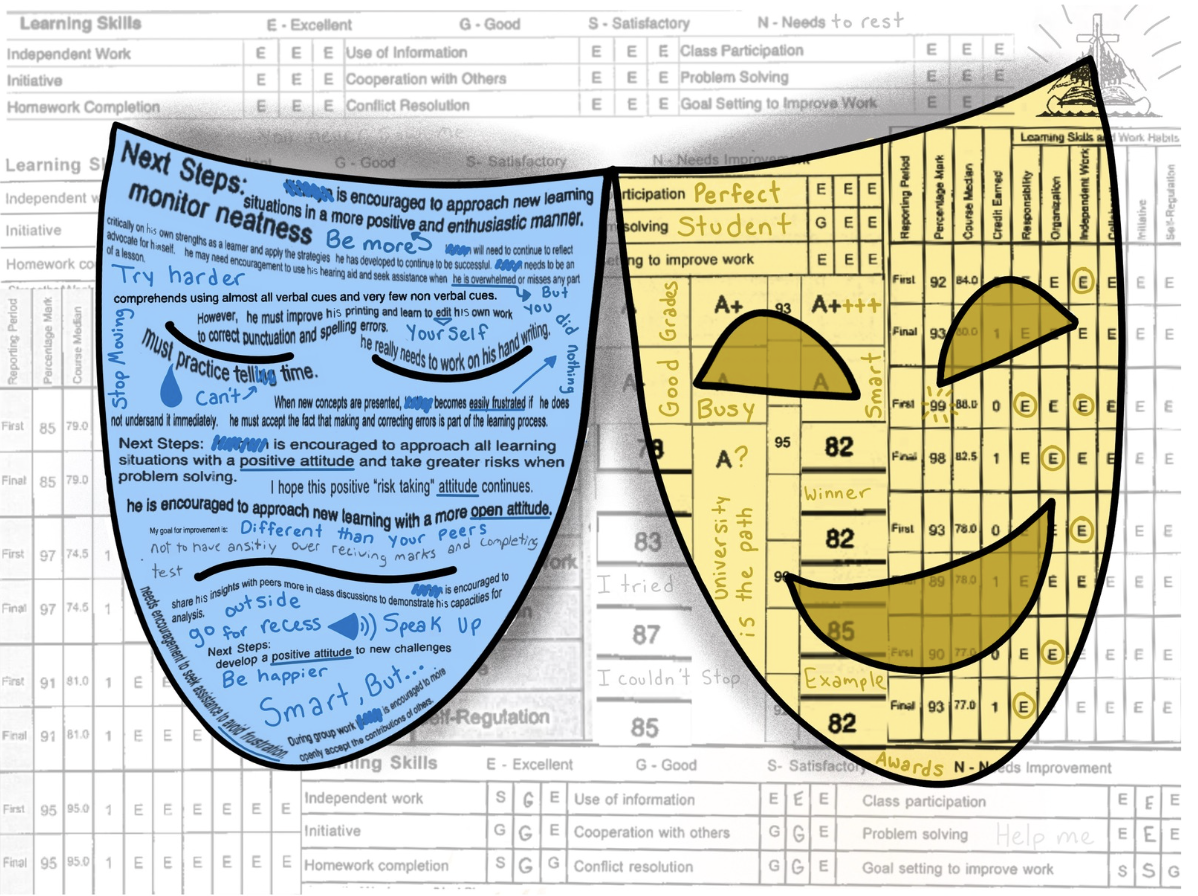
Graded by George
Image description: Click here.
“TRY HARDER”
“I initially felt frustrated then defeated reading report
card comments insisting that at best, I could
overcome my challenges if I just tried, and at worst,
my challenges were the result of poor behaviour.”
“Hopeless is how I felt.
Misunderstood and hopeless.”
-Sam
“Report Cards ... does not increase a sense of safety in
the classroom, and does not provide better support for
students. “
-Taylor
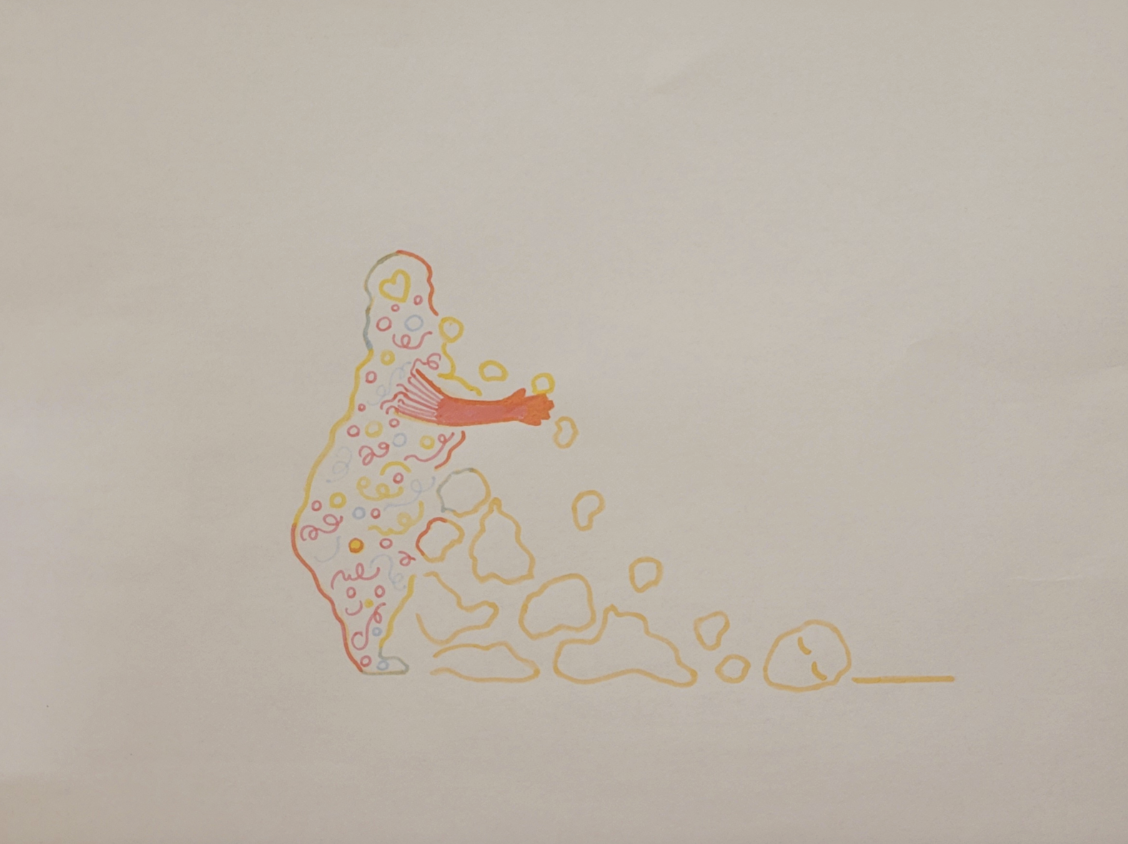
Built Down by Taylor
Image Description: A light orange outline of a body crumbling with vibrant red, orange and pink in the main shape of the body.
This work represents the crumbling of the self
as a result of the relentless evaluating and
expectations in educational settings, the
intensely coloured arm and hand represent the
pulling of all capacity in an attempt at
connecting with the evaluating adult despite
there being no possibility to because that
relationship is not based on connection due to
systemic demands, the visual analogy with
heart rhythm with a flatline at the end
represents the impact on self-love and self-
esteem and then on engagement with learning
and life, the large white space represents the
absence of reference and connection with self
and with the world that results from that type of evaluation in the educational setting.
“I was the problem”
-Nia
“...my challenges were my fault, and failing
to resolve these challenges was also my
fault. I felt blamed”
-Sam
“dumb”, “stupid” “slow”
-Fynn
“On report cards, I was ordered to “volunteer more in class”, to
address my “refusal” to interact with peers, and to “become a part of
the whole”. No matter that masking, to the extent that I was able,
took everything I had.”
-Sam
I’m grateful for the correct labels as I was called many unkind ones. The real ones would have saved me a lot of self blame and shame if I’d known them earlier. #NeverTooLateToKnow
-Morden
“I would say it made me feel left out and pushed to the side. The way the teachers treated people like myself for my autistic behaviours I would be on timeout, stand in the corner etc, while the other non-autistic students only got spoken to - this was awful
-Walter
The issue though, is that while a lot of the comments were positive, the inconsistency of my scores across subjects is evident. Yet it was downplayed. I think that the positive evaluations gave me and my parents a false sense of security. Growing up, I did not like to read my report cards upon just receiving them. I would feel apprehension. The positive comments about my diligence, or being "a good role model to peers" made me feel good about myself only temporarily. I wanted to then prove to teachers that this was true, sometimes to my detriment. I developed people-pleasing tendencies during school years. I still have to unlearn this tendency as an adult.
-Susan
“I do feel sorry for my younger self.”
-Gemma
A Child Like This by Freya
The problem ”with a child like this”
They gesture toward my son with an open palm
Whilst they keep their gaze on me
It’s as though he’s a piece of furniture
A misfit ‘misfitting’
Becoming problem
A disruption
To their otherwise neat order
As am I …
Mad identified
Autistic/ADHD
A Neuroqueer mother
The problem “with a child like this”
Again … again … more motioning
Pulling out a clipboard
Reducing him to dot points on a page
Feed-forward mechanisms
Functioning labels
that do nothing
Toward communicating life otherwise
Neurotypical architectures
Backgridding minor socialites
Divergent ways
Of becoming-with allways in-relation
There's no escaping
This narrow box
They have him in
Rapidly deflating
When we came in
To this room
So boyant
The problem “with a child like this”
They cant (they wont?)accommodate ... move
They don't know how to tread
Lightly ... care-fully with care in mind
But - life depends on care
Care is fundamental
To life
Essential for the survival
Of all of us
In all our bumptuous kinds
of difference
Affirming care — meaning welcome
Hospitality rather than tolerance
Encounter-exchange rather than
Business-exchange
A performative act
Is not only fundamental ...
It is vital
And vitally absent in this room
They are as perplexed by us
As we are perplexing
we are perplexing
we are perplexing
Im watching my son,
Who is watching me
The first to notice
My lip quiver
My unruly body
Feeling too much
‘Triggered'
The principal's office
The mediator's office
Detention ... Wandering hallways
The ‘DOG BOX’
A 1x2 meter locked room
Where I was isolated
For extended periods
of time
The problem “with a child like this”
I cant (I wont!) listen anymore
They think they have us pegged ... denial/grief
This normative mother
Im trying to perform
Is being made
Unreasonable
Loosing any credibility ... I thought I had
I stand up
Taking my son in hand and picking up my daughter, both of whom have not
stopped moving since we entered the room.
“I have to end this meeting” I say ... “I’m shocked that you would read –
with my son in the room - from these heavily deficit-based therapy
reports?!”
They respond with ...“yes, maybe you should take a break?”
The children and I step out of the room, folding into each other ... they
try to wipe away my tears ... my son asks “what’s wrong mummy?”
How can I answer that question?
Its July of 2025, my son (who attracted the label Autism at 3) is 6